
03. Why We Started an Open Class (and Collaboration Platform) on Reclaiming Development
 Mario Picon
 The people who drive us.
There are conferences happening right now about the future of development. Panels, white papers, strategy memos, closed-door convenings.
Yes, the future of development is being actively discussed. And yet, something feels off.
The same people talking. The same frameworks. The same institutional language. The same comfort zones. All while the ground of the field many of us built a career on is shifting, under shrunk budgets, and eroded trust in institutions, people and processes.
Young professionals are wondering, and rightly so, whether this field still has a future. Just last week, a brilliant student of mine told me she had finally decided to change career focus.
And communities around the world dealing with climate collapse, extractive politics, exclusion, do not have the luxury of theoretical debates.
So we asked, from our privileged but small role as a governance lab, just a simple question:
What would it look like to actually open the conversation?
Not another panel. Not another careful blog post. Real opening.
Overcoming legacy
International development carries a long history. Some of it inspiring. Some of it uncomfortable.
Whether we admit it or not, that history shapes our toolkit. We inherited logframes, rigid theories of change, measurement systems obsessed with GDP, and institutional hierarchies that still assume expertise flows from the center to the periphery.
… And you could hear the friction in our class chat.
Martin, joining from Uganda, wrote: “Economic growth is misleading… Uganda is growing at 7 percent per annum but her citizens are still poor.”
Sobeida, a governance professional formerly with USAID in Peru, pointed out the contradiction of extractive growth coexisting with poverty—especially in regions sitting on vast mineral wealth.
Elana, coordinating a global civil society network, reflected on how African colleagues are cautious but hopeful about reimagining development in ways that move beyond its colonial inheritance.
These aren’t abstract critiques. They’re lived tensions. Signals that the vocabulary we inherited no longer holds.
If development is going to remain relevant in a world shaped by climate instability, inequality, and geopolitical fracture, it cannot keep relying on the same mental models.
Development is not a finished doctrine. It is an unfinished experiment.
Opening the doors is no longer optional
The idea wasn’t visibility, brand or enrollment metrics—though seeing participants join from Botswana, Malaysia, Afghanistan, Nigeria, Mongolia, Cambodia, Spain, Germany, Peru and beyond tells us something is stirring.
The idea was simple:
If we are serious about rethinking development, we cannot do it behind closed doors.
We need practitioners in Zambia. Policy advocates in Malawi. Nutrition specialists in Cambodia. Governance officers in Mongolia. Reformers in Peru. Civil society leaders in Nigeria.
But not as audience members. Rather, as co-thinkers.
During our first session, Sobeida from Peru wrote: “Perhaps the focus should emphasize the agency of people and institutions to ensure they will be autonomous in the near future.”
That sentence alone justifies the class.
Reclaiming development is not about abandoning it. It is about taking responsibility for it.
Development as a shared responsibility
One of the most persistent illusions in our field is that development is a sector. It isn’t. It is a societal endeavor.
Private sector actors shape incentives. Government officials shape policy and implementation. Academics shape frameworks. Civil society shapes accountability. Young people shape political momentum.
Daniela, joining from France, challenged us directly: “May we, in spaces about democracy, policy reform and climate justice, move beyond diversity and work to decolonize our teachings too.”
Wilkister from Kenya asked: “How can we beat the old guard with messaging?”
These are not classroom exercises, but political questions.
The skills development professionals have cultivated—navigating complexity, working across cultures, operating in political gray zones—are not obsolete.
They are more needed than ever.
But they must be practiced in partnership, not isolation. As my friend Tommasso Balbo di Vinadio brilliantly put it on a recent chat we had.
Navigating the system, while creating the conditions for change
In conversations with Tracy Jooste and our broader team, we kept returning to one idea:
How do we create buffers—spaces at the edge of systems—where new ideas can be tested without being crushed by institutional gravity?
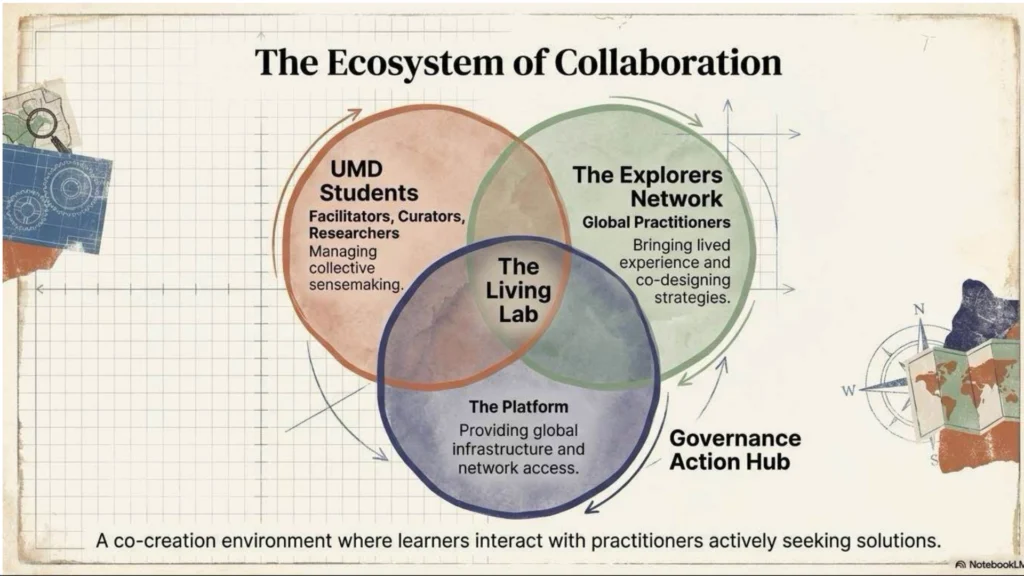
That’s what this class is. A buffer. A live experiment.
A place where Mmabatho from Botswana reflects on storytelling as a lever for governance reform. Where Mary wrestles with the tension between producing research and wanting change to feel alive. Where Anna, joining from Berlin, reminds us not to give up on public leadership even when institutions feel brittle.
This is not neat, fully structured, or uniform. But it is alive. And aliveness is what development needs right now.
Reclaiming, with purpose
We chose the word reclaim deliberately.
Because if we don’t own this field, others will define it for us. If we don’t fight for it, it will either calcify into irrelevance or be captured by interests that care little for inclusion.
Reclaiming development means democratizing the debate. Making theory useful again.
Moving from “experts explain” to “participants co-design”: connecting local experiments across borders; turning conversation into prototypes; and turning prototypes into collaborative action.
This class connects more than 500 people across time zones.
But numbers are not the point. If even 30 of them begin to act differently in their institutions… If 10 of them start local experiments… If 3 of them connect across borders and build something new…
The ripple begins. And that’s how fields change.
Join us. Let’s make this call to service that is development, contagious.
From the only journal that sends you a hug.
Mario
Join the Governance Explorers
We are bringing together a global network of people eager to rethink governance and influence local, national and global debates.
"Goodwill from both government and local community leaders is essential for successful climate action"

"The question is how do you get the good idea to reach the right people to make change?"