Beyond the Playbook: Navigating Territorial Complexity and Finding the Others
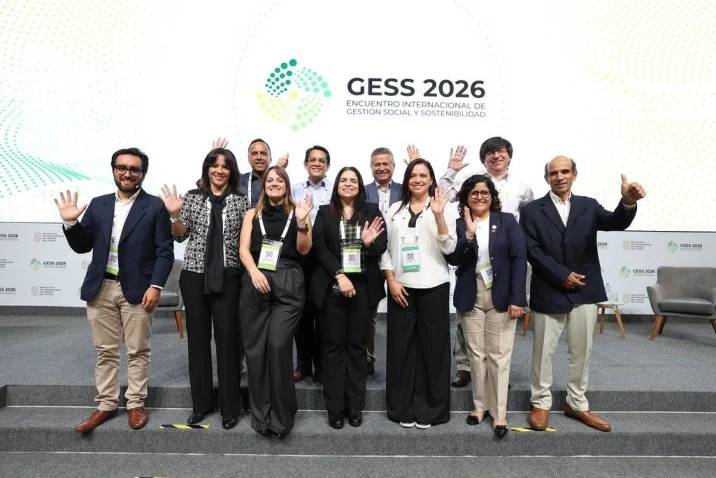
Good afternoon, everyone.
As we bring this intense, rich first day of GESS 2026 to a close, we need to take an honest look in the mirror. We have spent the day engaging in debates on why and how to innovate, participating in strategic workshops, and listening to forward-looking frameworks.
This morning, Juan Carlos Ortiz, President of the Instituto de Ingenieros de Minas del Perú, laid out a premise that should resonate with every technical leader: solving development challenges requires far more than engineering and production prowess. It demands the institutional capacity to dialogue, relate, and build trust. Tamiko Hasegawa reinforced this: no investment or operation is sustainable if it is designed and executed in isolation from its surrounding territory.
If there is something common across every session today, it is the understanding that the traditional playbook of corporate ‘social management’ has reached its ceiling. And it is about time we build a different paradigm. Here is a suggestion on how.
Breaking the illusion of the Good Practice Recipe
For decades, the extractives and energy sectors approached social engagement through an underlying, conscious or unconscious, transactional mindset. We operated under the assumption that if we applied a rigid formula, being a predictable schedule of consultation workshops, a checklist of compensations, and corporate firefighting to prevent operational stoppages, we could guarantee the operation’s viability.
Without intending to, the private sector often stepped in as a “substitute State,” financing isolated public works that cemented local dependency rather than fostering lasting institutional autonomy. Several speakers, many from companies, decried today that role yet it has come to be usual, almost expected practice.
Today, we know this model is exhausted. What appeared to work in one valley five years ago falters completely in the neighboring basin today.
The reason: what we collectively now aspire to and foster, territorial development, is not a closed system achievable through a project mindset. It is a living, complex, adaptive system shaped by historical grievances, power asymmetries, and competing visions of the future.
To the many mining, civil, and environmental engineers in this room: your disciplined problem-solving mindset is an indispensable asset for our region. You calculate rock stresses, optimize logistical corridors, and run sophisticated operations with precision. But human territories cannot be modeled in the same way. We need to innovate in the way we approach the territory and connect with people.
True innovation in social management does not mean rolling out an app, deploying more drones, or facilitating another post-it brainstorming session. Innovation is about, fundamentally, rethinking governance.
Governance not as an organizational chart in a corporate presentation or an administrative manual. Governance rooted in its original meaning, governance as the living, adaptive process of steering shared decisions and guiding multiple actors toward a common goal, across complex, unfamiliar, and uncertain terrain.
Processes to Watch: Global and Local Evidence
When faced with this systemic complexity, the most common institutional reaction is paralysis: “We don’t have a corporate mandate for this,” “My board only measures whether the road was blocked this week,” or “The local municipality lacks technical capacity“.
We condition our action on the arrival of an ideal scenario or a global guideline.
Yet across the world, transformative shifts never started because someone had an ideal operating environment. They began because practical leaders decided to look at their square meter and experiment with a different governance architecture:
- In Colombia’s Sierra Nevada: Through the Terra Initiative, Greenwood Energy and the Arhuaco indigenous authorities did not settle for a standard consultation. They invested five years in co-designing a 25-year clean energy framework where the land is never sold, a dedicated percentage of power revenues feeds an autonomous fund to reclaim ancestral lands, and after 25 years, the entire solar asset transfers to the community alongside fully built local technical capabilities. It is a young process that we must continue to evaluate, but it breaks the transactional mold by anchoring long-term co-ownership.
- In Mongolia’s Gobi Desert: At Oyu Tolgoi, protracted disputes over deep groundwater between nomadic herders and the mine were transformed into an independent, permanent Tripartite Council with open hydrological data and joint binding oversight.
- In South Africa’s Mpumalanga Region: Facing the imminent decommissioning of coal-fired power stations, engineers, labor unions, and municipal leaders sat together to co-design agrivoltaic pilots and local workforce transitions before shutting down the turbines, turning an economic threat into a productive transition.
- Or here in Peru: We see the power of replacing suspicion with objective, open evidence. In Moquegua, the deployment of real-time participatory water telemetry with agrarian user boards and regional oversight proved that transparent data replaces mistrust with technical dialogue.
None of these teams had guaranteed outcomes. What they had was the courage to take measured risks and innovate in how they govern relationships.
We Cannot Do this Alone: Moving to Co-Implementation
There is a vital lesson embedded in these experiences: no single stakeholder can (or should) resolve territorial development in isolation.
The private sector cannot buy social peace. The State cannot regulate trust into existence from a central ministry in Lima. Civil society cannot deliver systemic scale without partnerships.
As Rubén Cóndor, Executive Secretary of the Mesa de Concertación para la Lucha contra la Pobreza, emphasized this morning: holding meetings is not the same as securing durable agreements, and executing budget is not the same as generating territorial transformation.
In Peru, we have historically excelled at the co-creation of visions. We design national roundtables, diagnostic commissions, and comprehensive frameworks. But initiatives falter when we fail to build the institutional machinery for co-implementation and shared ownership. When the pilot ends, the grant expires, or key executives relocate, the initiative stops because the territory was never a genuine co-owner of the process.
This is why inclusion and multi-actor collaboration are not soft, polite corporate principles. They are operational necessities and political imperatives.
When we distribute leadership across company, State, and community:
- We uphold the Principle of Non-Substitution, deploying instruments like Obras por Impuestos to reinforce public municipal planning rather than bypassing it.
- We stop waiting passively for political windows of opportunity to appear—we actively generate the conditions to open them.
- We move from temporary social licenses to durable territorial resilience.
The Call: Finding the Others
I recently found this quote which I am obsessed with now, because it captures our exact mandate as we look forward to tomorrow:
“Our job is not to convince everyone; our job is to find the others.”
Who are the others in our extractives, energy, and territorial ecosystems?
- The others are the corporate operations managers, superintendents, and finance directors who recognize that transactional handouts create vulnerability and are ready to back an adaptive pilot.
- The others are sector leaders in government—like Vice Minister of Mines Mayra Figueroa, who has spent years championing the Mining Integration Program to build preventive territorial networks and genuine dialogue across regions.
- The others are civil society pioneers and institutional bridge-builders—like Roy León in Cajamarca, Iván Ormachea at ProDiálogo, and Cecilia Villegas at Capitalismo Consciente—who insist that trust requires radical coherence and treating the other as an authentic equal.
- The others are the municipal planners, regional teams, and grassroots community organizers who, working against institutional scarcity, show up every day to unblock vital public infrastructure for their people.
Our mission is not to exhaust ourselves trying to convert those who remain anchored in the old paradigm. Our mission is to identify, connect, and empower the critical mass of constructive changemakers already working across companies, public entities, and communities.
Innovation does not survive in corporate isolation. It thrives when we build platforms of trust where the others can experiment together, learn from failure responsibly, share risk, and demonstrate in practice that co-responsibility delivers sustainable value.
Connecting Innovation in Governance to Trust and Sustainability
Tomorrow, GESS moves into its second core axis: Trust. On Day 3, we will tackle Sustainability.
None of our upcoming discussions on trust will matter if we do not commit to changing our day-to-day posture in the field. Trust is not decided in a public relations campaign; it is earned through the cumulative consistency of transparent, shared processes.
As we leave this room today, let us take on three practical commitments:
- Shift our organizational culture: Stop measuring social success by the absence of noise or the volume of transactional expenditure, and start rewarding adaptive leadership that builds residual local capacity.
- Embrace the scientific mindset: Adopt the curiosity of a researcher – treat strategies as hypotheses to be tested, create safe spaces to learn from operational missteps, and adapt when local dynamics demand it.
- Seek out the others tonight: In the hallways, at the opening reception, and throughout tomorrow’s sessions, find that colleague from another company, that public official, or that community representative with whom you can start co-designing a shared governance mechanism.
At the Governance Action Hub, alongside our partners at Andean Link Engagement, this is the exact work we are advancing through an Inter-Regional Action Platform, connecting subnational leaders across regions like Moquegua and Cajamarca to turn governance from theory into shared execution.
The future of social management and territorial development in Latin America will not be dictated by an imported manual. It is being built right now, from the ground up, by leaders who have the clarity and courage to navigate complexity together.
Thank you very much.
Join the Governance Explorers
We are bringing together a global network of people eager to rethink governance and influence local, national and global debates.

"Goodwill from both government and local community leaders is essential for successful climate action"

"The question is how do you get the good idea to reach the right people to make change?"