Making Democracy Irresistible: Katy Rubin on Theatre, Trust, and Real Policy Change
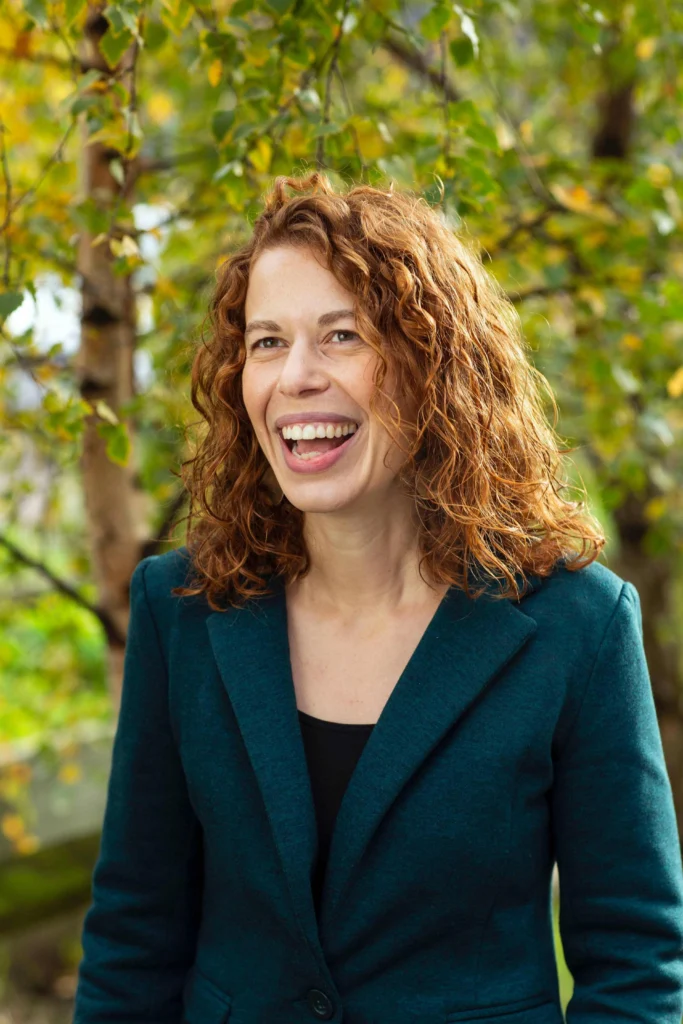
For Katy Rubin, a member of the Governance Action Hub’s Explorer Network, this is the focus of her work as a legislative theatre practitioner, designer, and creative civic strategist based in Manchester. She also coordinates The People Act, a hub for legislative theatre resources.
Katy describes legislative theatre as a way to bring people’s lived experiences into policymaking, not through a consultation form or a formal meeting, but through performance, shared problem-solving, and public commitment.
“I guess my eternal question is, how can we experience joy and fun and delight while making urgent change that needs to happen on issues that are important to us and to our neighbors,” she says.
For Katy, legislative theatre brings together two things that are often kept apart: the seriousness of democratic action and the creativity, play, and energy of theatre.
“We can have serious fun,” she says. “We can make democracy irresistible.”
What is Legislative Theatre?
Legislative Theatre brings residents and policymakers together to co-create innovative and effective solutions to complex challenges, promoting equity, creativity, and fun in local and national political spheres.
From lived experience to policy ideas
Legislative theatre starts with a real-world problem. It might be homelessness, public space, access for disabled people, school relationships, or another issue where everyday life is shaped by rules, systems, and decisions made elsewhere.
It starts with the people living closest to the issue. Participants share stories about where policies, processes, or institutions are not working for them. Through games, discussion, and reflection, those stories are shaped into scenes.
For Katy, theatre is not just a creative add-on. It helps people see the human consequences of policy choices.
“Sometimes policymakers don’t really understand the nuance of how policies are impacting people,” she explains. “And from seeing the story, we start to have a shared understanding.”
That matters. People are often asked for solutions before everyone has really understood the problem. Legislative theatre slows that down, but in a way that feels active, creative, and alive.
It gives communities and decision-makers something they can work with together: a live situation where ideas can be tested, adjusted, and tested again.
Watch, act, propose, vote
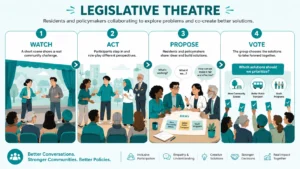
Katy describes the legislative theatre process in four steps: “watch, act, propose, vote.”
First, people watch a play based on real experiences. Then, audience members are invited to step into the scene and test possible changes. Those ideas are shaped into proposals. Finally, participants vote on which ideas should be taken forward.
But the vote is not the finish line.
Then comes the important part: what will decision-makers actually do next?
Policymakers involved in the process are asked to make a practical commitment: what action will they take in the following weeks to move at least one idea forward? That step helps turn participation into something concrete. People are not only invited to speak; they are invited to help shape proposals, test them, and see what institutions are prepared to do in response.
As Katy puts it, legislative theatre can “turn a story into a play, into an idea, into a reality.”
A small change that made a real difference
One of Katy’s examples comes from Medway in Kent, where legislative theatre was used as part of work on a rough sleeping strategy.
People experiencing homelessness described a problem with the process used to confirm whether someone was sleeping rough. A person might tell the council where they were sleeping, but if officials came to check on an unannounced night and the person had moved, because of rain, safety concerns, illness, or another reason, they could be pushed to the bottom of the list for emergency accommodation.
“It’s a policy problem,” Katy says.
In the play, a woman experiencing homelessness tells the council she is sleeping outside a McDonald’s. But on the night officials come to verify her situation, she has moved into a doorway because she feels unsafe. The audience knows where she is. The charity worker knows. But the system does not allow that knowledge to count.
The scene helped people understand both the absurdity and the seriousness of the situation.
Through the process, participants proposed a practical change: allow multiple homelessness charities, who regularly saw people sleeping rough, to contribute to verification in coordination with the council.
The idea was voted on, reviewed, and implemented. According to Katy, it meant people were able to access help much faster. The change later became part of Medway’s formal strategy, and Katy says it also influenced wider thinking about how local councils could interpret national requirements.
“I love that story because the theatricality of it absolutely helped us understand the ridiculousness and the simplicity of solving it,” she says.
Why theatre can build trust
Katy sees legislative theatre as especially useful where trust between communities and institutions has been damaged or is under strain.
The process builds trust in a few ways. First, people get to understand the problem together. Second, community members and policymakers solve problems in the same room, rather than being kept apart. Third, everyone takes a risk.
Communities take a risk by sharing personal stories. Policymakers take a risk by stepping outside usual procedures and making public commitments. In that shared vulnerability, trust can begin to grow.
Katy puts it simply: “Democracy should be working together too.”
Taking fun seriously
One of the most striking parts of Katy’s approach is her insistence that fun belongs in democratic life.
For her, fun is not a distraction from serious issues. It can make people more imaginative, reduce rigid power dynamics, and make participation something people want to return to.
“I’m having fun. I could think of things upside down,” she says. “And if we’re not thinking about things upside down at this moment in history, we’re wasting our time.”
That point matters. Many participatory processes depend on people giving their time repeatedly. If those spaces feel inaccessible, overly technical, or exhausting, many people will not come back.
The goal is not participation as a one-off exercise. It is participation as something people want to keep doing.
Starting where people are
Legislative theatre does not have to begin with a large production. Katy notes that some processes take place over several weekends, while others can happen in a single day. What matters is having enough time to understand the problem, involve the right people, and create a route toward action.
For anyone interested in testing the approach, she suggests starting with a few practical questions: Where are existing participation methods not working? Where is there tension, conflict, or exclusion? Where are the same solutions being repeated without progress? And where are the people most affected by a problem missing from the conversation?
These may be the kinds of situations where legislative theatre can help: when institutions need to better understand lived experience, when communities need safer ways to express what is not working, and when everyone involved needs more creative solutions than the usual process is producing.
A more human way to make policy
Katy’s work is a reminder that policymaking is not only about evidence, procedures, and institutional mandates. It is also about relationships, trust, imagination, and the ability to see how systems are experienced by real people.
Legislative theatre is not the only answer. But it opens a door that many formal processes leave closed.
The lesson is simple but powerful: when people can test solutions together, policy feels less remote and starts to respond more directly to real life.
As Katy says, “Everyone is an actor because they take action in their lives.”
Recent writing
Join the Governance Explorers
We are bringing together a global network of people eager to rethink governance and influence local, national and global debates.

"Goodwill from both government and local community leaders is essential for successful climate action"

"The question is how do you get the good idea to reach the right people to make change?"